New blog post from Dr. Mezuk

We are excited to share a recent blog written Dr. Mezuk and published in the Interdisciplinary Assocation for Population Health Sciences (IAPHS) Blog

In the article, Dr. Mezuk reflects on what it means to ‘invest’ in science and health research within the context of the current administation’s push to reduce “government waste” and reconsider federal funding for the health sciences. The article draws from the investment advice of Warren Buffet to outline concrete ways in which we can improve our approach to federal and societal investment in health, calling into question what role investment has in population health research and the pursuit of health equity (who benefits from advancements in health research?).

You can read the full blog entitled “Investment Advice for America’s Health: How Words From the “Oracle of Omaha” Apply to Government Funding of Research” here.

Congratulations to Dr. Eskira Kahsay!

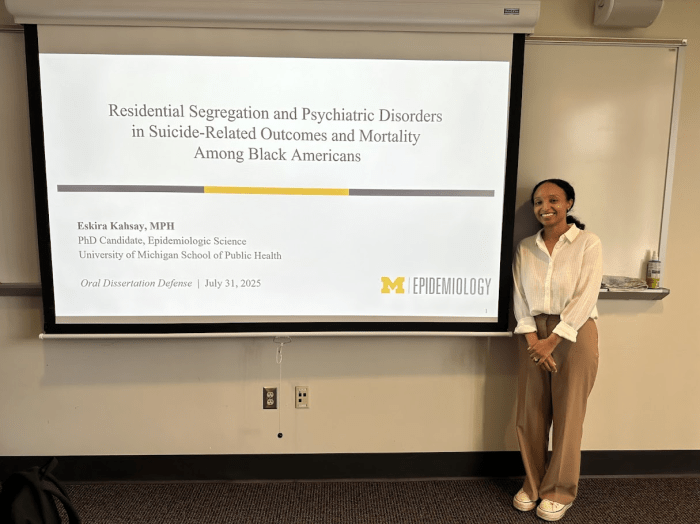
We are very excited to announce that GREMAP PhD student Eskira Kahsay has successfully defended her dissertation! Her dissertation was titled “Residential Segregation and Psychiatric Disorders in Suicide-Related Outcomes and Mortality Among Black Americans”. This work leveraged two key datasets — the National Survey of American Life and the National Violent Death Reporting System— to provide a valuable contribution to our understanding of how structural and spatial determinants of health impact mental health and suicide risk within the Black population. Congratulations to Dr. Kahsay!

GREMAP at the ADA conference!

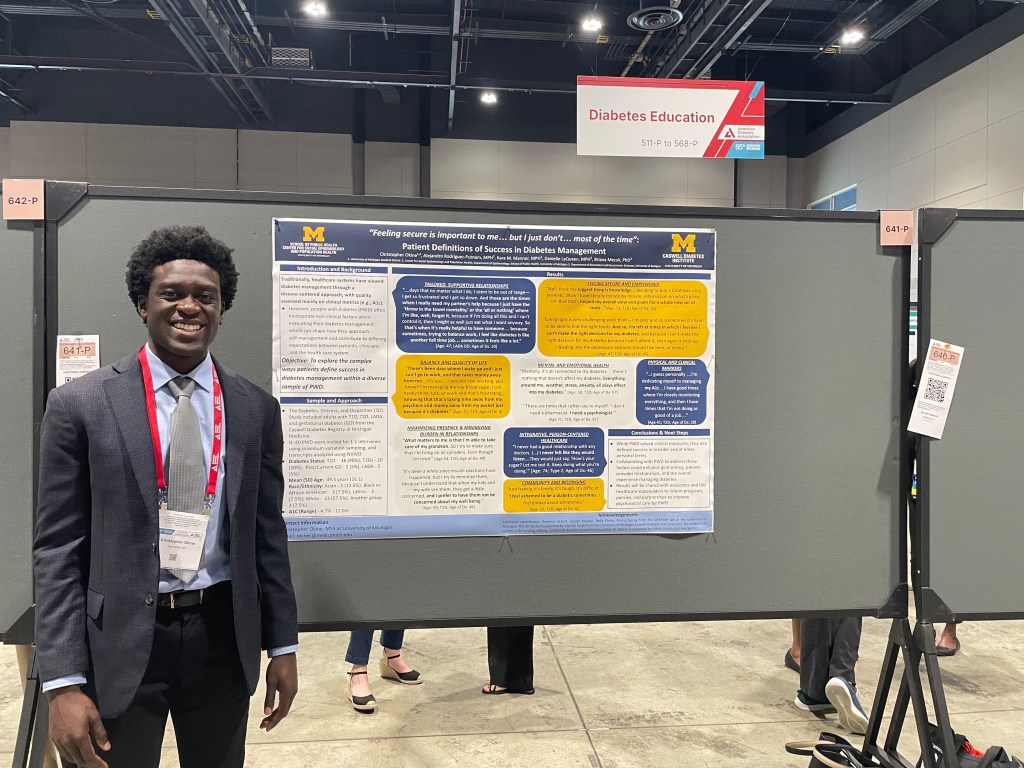
Last week, medical student and GREMAP collaborator Chris Okine presented at the American Diabetes Association (ADA) annual conference, which took place in Chicago, IL. Chris presented his poster entitled “‘Feeling secure is important to me… but I just don’t… most of the time’: Patient Definitions of Success in Diabetes Management”, which analyzed qualitative data from Diabetes, Distress, and Disparities (3D) Study to explore how people with diabaetes (PWD) define ‘success’ in the management of their diabetes. For example, PWD in the 3D study sample defined success in a broader sense, including the impact of managing their diabetes on their relationships, their sense of balance and quality of life, and their mental and emotional health, in addition to clinical markers (e.g., A1c) often used in a healthcare setting.

Overall, the ADA conference was a great opportunity to connect with other researchers and clinicians and to share our work with a broader audience focused on diabetes. Chris shared that many people were interested in the quotes and specifics about patient experiences with defining success as it relates to their diabetes management. Attendees were also interested in learning more about how definitions of success varied by diabetes type. In addition to the poster session, Chris connected with other presenters as well as faculty from UM who study diabetes. Great work, Chris!

Left: Chris presenting his poster at the poster session; Right: Chris at the ADA conference entrance.

GREMAP at the PSAD conference!

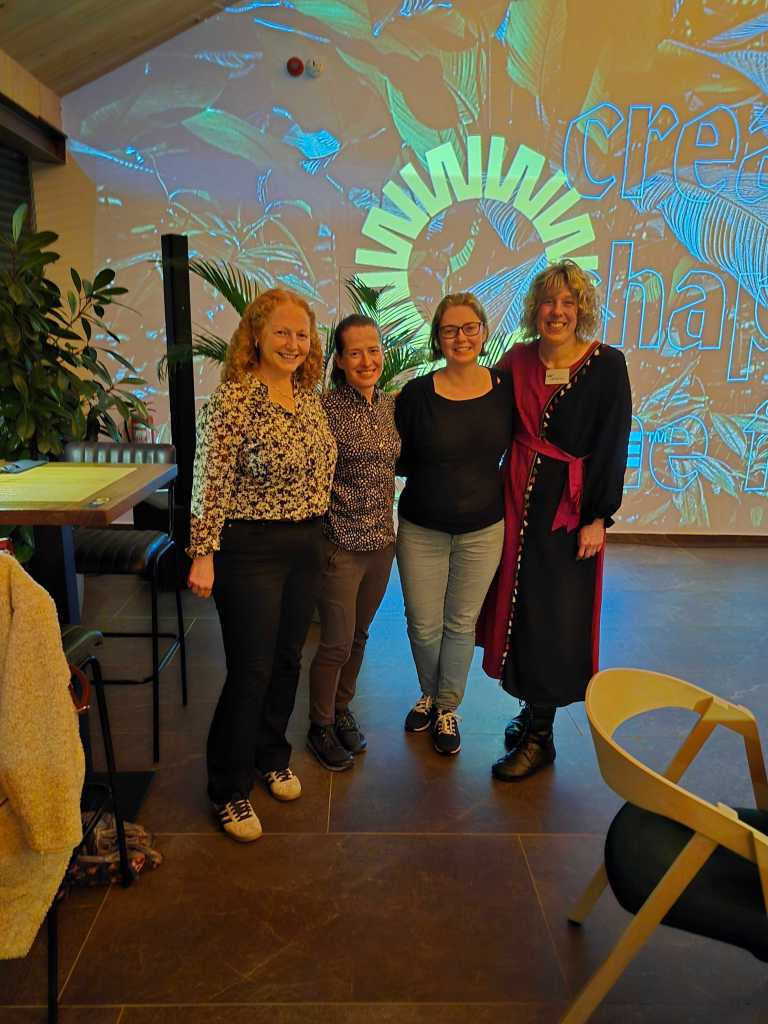
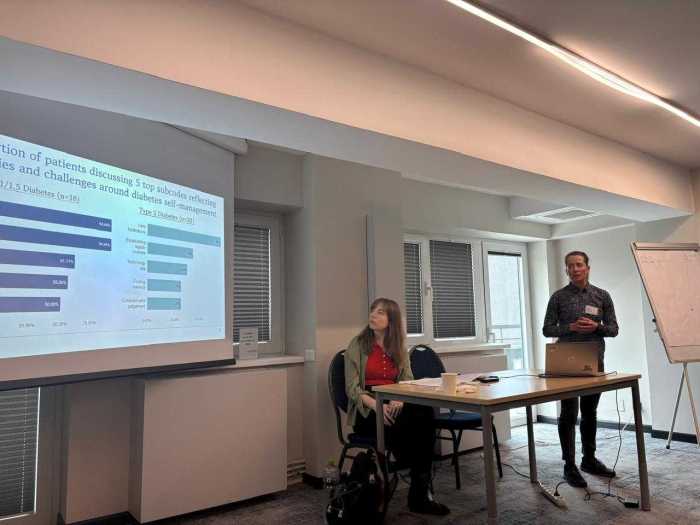
In May, Dr. Viktoryia Kalesnikava presented at the Psychosocial Aspects of Diabetes annual meeting, which was held in Cluj-Napoca, Romania. Dr. Kalesnikava presented qualitative findings from the Diabetes, Distress, and Disparities (3D) Study, which was fielded in 2024 as a part of GREMAP’s Diabetes and Mental Health (DMH) Initiative. The presentation was titled “’When I do feel confident and secure, I feel more like my old self’: Patient perspectives and priorities in diabetes management” and highlighted patient perspectives and perceptions of their health and care needs related to diabetes. Dr. Kalesnikava also chaired a session on stigma and support at the conference. You can find the full conference proceedings here.

Left: Viktoryia (middle-left) and collaborators at PSAD.

Below: Viktoryia presenting the work from the 3D Study in the PSAD session.

Congratulations to Lauren Kouassi!

We wanted to give a shout-out to GREMAP MPH student Lauren Kouassi, who is joining the UM Injury Prevention Center as an intern this summer. Lauren will be working on a project to evaluate implementation of the Know the Signs program at schools in the Bronx District 9. The goal is to understand school-level outcomes, student-level outcomes, and the implementation of the program, such as cultural tailoring practices. Enjoy your internship, Lauren! We are looking forward to hearing about your work.

GREMAP at the 2025 APS conference!

Last month, Dr. Briana Mezuk presented at the Association for Psychological Science (APS) annual meeting in Washtington, D.C. Dr. Mezuk gave a talk on the MIWI program as a part of a broader session on advancements in social sciences research. The session was titled “30 Years of Advancing Behavioral and Social Sciences Research to Improve Health for All” and was organized by the Office of Behavioral and Social Sciences Research (OBSSR) at NIH. You can find more information here.

Dr. Mezuk (far right) with her co-presenters at APS.

DMH Study featured in Caswell Diabetes Institute Annual Report

We are excited to share the Annual Report from the Caswell Diabetes Institute, which highlights the institute’s achievements in research, education, and patient care here at UM. The report also features our work on the DMH Study, which is supported by a project grant from the Caswell Institute. On page 30, they showcase our progress in research, training, and mentorship and highlight our key findings from the 3D Study, which was fielded in 2024. You can read the full report here.

Reflections from Chris Okine

In GREMAP, we have been fortunate to welcome medical student Chris Okine to our team for the last two semesters. Chris is in his third-year at the University of Michigan Medical School and has been working with us on the Diabetes and Mental Health Initiative, or DMH project. 

Chris was recently awarded funding from the NIH-supported Short Term Biomedical Research Training Program (SBRP), which is a two-month program designed to support medical students in integrating research into their training. As a part of the SBRP program, Chris was able to spend the two months working on the DMH project, focusing mainly on analyzing the qualitative interview data from the Diabetes, Distress and Disparities (3D) Study

Following the SBRP program, Chris wrote up his reflections from participating in the program and engaging with health research more broadly. We wanted to share these reflections and highlight his experiences with research from the perspective of a medical student and future clinician. 


My name is Chris Okine, I’m currently a third year student at the University of Michigan Medical School! During my first few years in the school, we focused on science and physiology, with the second year devoted more towards learning how to apply this knowledge and care for patients. However, during this second year, most students, like myself, quickly realized that there was a difference between “provider’s perspective” and a “patient’s perspective” in disease management. Sometimes this difference would affect patients negatively, and I realized that it was an important skill to be able to center the real experiences of patients managing their diseases, while facing the realities of working as a provider in this current healthcare system. Due to my own struggles navigating this, I knew by the end of my second year that I wanted to find a way to better understand what patients were experiencing on a daily basis. 

I was afforded this opportunity by applying to the NIH Supported Short Term Biomedical Research Training Program (SBRP), which allows medical students to receive funding and take two months to spend fully on research. I was able to undergo this program by joining the joining the Diabetes and Mental Health (DMH) project, which consists of a team that is part of Dr. Briana Mezuk’s Group for Research on the Epidemiology of Mobility, Aging and Psychiatry (GREMAP). Since much of my training had described mental or emotional health as separate from other medical problems, it was interesting to see how Dr. Mezuk and lab members focused on the interaction between the two, often framing mental health as a symptom of the actual disease. Additionally, everyone in the lab was very welcoming and kind, and there was a spirit of self-growth, collaboration, and excellence that I was really drawn to. 

To apply to the SBRP program, I submitted a proposal for a research project, which focuses on launching a qualitative analysis on data gathered through the Diabetes, Distress, and Disparities (3-D) Study, which was recently conducted to better understand the psychosocial needs of patients with diabetes. In line with my interests, I decided to focus on a patient’s “definitions” of success, when it comes to diabetes management, and how this may differ from traditional markers of success. Through this study I was hoping to find ways physicians and future providers (like myself) can tailor discussions and treatment plans to align with patient priorities  and goals. 

During these two months, I worked on a project timeline, learned about appropriate qualitative analysis methods for this study, and conducted a literature review focused on patient perspectives in diabetes management. I also met often with people from different disciplines within and/or associated with the lab who constantly gave me advice and direction. It was also very helpful to be able to bring my work to our weekly lab meetings, where everyone was eager to give feedback and advice on next steps. I did not have much research experience prior to joining the lab, and this project gave me the perfect opportunity to learn more about what goes into research. I was also able work with other colleagues in the lab to have this work accepted as an abstract titled: “Feeling secure is important to me… but I just don’t…most of the time”: Patient Definitions of Success in Diabetes Management”  for the 85th American Diabetes Association Annual Conference this summer. Furthermore, a key aspect of my program was gaining insight into how research drives improvements in the healthcare system. I’ve come to understand that any change within a large healthcare system involves multiple stakeholders, making it essential to consider these broader, “big picture” factors throughout the research process.

Throughout my time in the lab so far, I’ve learned valuable lessons about how to think about research, pathways to impact, centering community, and leading a project. Furthermore, it has inspired me to see my role as a physician differently. I aspire to become a provider who prioritizes not just the health outcome, but the process and journey taken alongside each patient to achieve it. As I progress through my studies and rotations, I am committed to a holistic approach to care- one that integrates the physical, mental, and emotional well-being of my patients while remaining mindful of the psychosocial factors that shape their experiences.